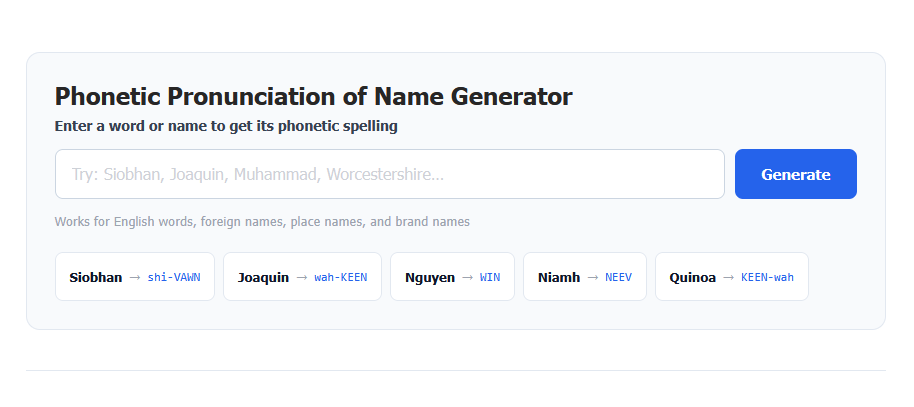
This phonetic spelling generator converts any word or name into a clear, easy-to-read pronunciation guide — instantly and for free. If you have ever wondered how to phonetically spell your name, simply type your name or word in the box above and get the phonetic pronunciation in five formats: simplified phonetics, syllable breakdown, IPA, NATO alphabet, and telephone spelling. No sign-up, no download — just type and copy.
Phonetic Pronunciation of Name Generator
Works for English words, foreign names, place names, and brand names
What Is a Phonetic Spelling Generator?
A phonetic spelling generator is a tool that converts any word or name into its pronunciation form — showing you exactly how it sounds, not how it is written. English spelling is inconsistent. The same letters can sound completely different depending on the word. Phonetic spelling removes that confusion by giving you a readable sound guide.
When you use this phonetic spelling generator, you get output like shi-VAWN for Siobhan, or wah-KEEN for Joaquin. Anyone can read those and say the name correctly on the first try. No guessing, no awkward corrections.
This kind of tool is also called a phonetic name converter, a word pronunciation generator, or a phonetic pronunciation tool. They all solve the same problem — showing you the sounds behind the spelling.
How to Get the Phonetic Spelling of Your Name
Getting the phonetic spelling of your name takes under five seconds. Type your name in the box above and click Generate. You immediately get five output formats to choose from — pick the one that fits your situation.
Phonetic Spelling of Your Name on a Resume
One of the most common reasons people look up the phonetic spelling of their name is for their resume or LinkedIn profile. Adding pronunciation next to your name removes awkwardness during interviews and makes a strong first impression — especially for recruiters who want to say your name right before you walk in.
Priya Nair (PREE-yuh NAIR)
Xiomara Reyes (syo-MAH-rah RAY-yes)
Oluwaseun Adeyemi (oh-loo-wah-SHAY-oon ah-DAY-yeh-mee)
Copy the Simplified result from the generator above and paste it in brackets next to your name. Simple and professional.
Phonetic Spelling of My Name for Graduation
Many schools now ask students to submit the phonetic spelling of their name before graduation so the announcer can say it correctly during the ceremony. Use the Simplified output from this generator for that — it uses plain English that any announcer can read without any special training.
Phonetic Pronunciation of Name for Podcasts and Events
Podcasters, event hosts, and MCs regularly search for the phonetic pronunciation of a name before they go live. Mispronouncing a guest’s name is embarrassing for everyone. Use this tool before every recording or event — it takes ten seconds and avoids a mistake that your guest will remember.
How to Phonetically Spell My Name — Step by Step
If you want to understand how to phonetically spell your name manually — not just use the generator — here is the method. This is useful when you need to verify a result or create a phonetic guide for a very unusual name.
Listen to the actual sounds — not the letters. English letters and sounds are completely different things.
Each syllable has one vowel sound. Clap once per syllable to count them. “Mi-cha-ela” = 4 claps.
Use plain English letters. Write “ay” for the long-A sound, “ee” for long-E, “oh” for long-O, and so on.
Use hyphens between each part: mi-KAY-luh tells the reader exactly where to pause.
The syllable you say louder or longer gets capital letters. This is the most important step — it tells people where the stress goes.
Examples — how to phonetically spell these names
- Michaela → mi-KAY-luh (stress on KAY)
- Rahul → RAH-hul (stress on RAH)
- Fatimah → FAH-ti-mah (stress on FAH)
- Alejandro → ah-leh-HAN-droh (stress on HAN)
- Oluwaseun → oh-loo-wah-SHAY-oon (stress on SHAY)
Who Uses a Phonetic Spelling Generator?
A phonetic spelling generator is useful in more situations than most people realise. Here are the most common real-life uses:
Most Mispronounced Names — Phonetic Spelling Reference
Some names are consistently mispronounced because their standard spelling gives no clue to how they actually sound. Here is a reference table of the most commonly mispronounced names with their correct phonetic pronunciation. Click any row to load it into the generator.
| Name | Correct phonetic spelling | Common mistake | Origin |
|---|---|---|---|
| Siobhan | shi-VAWN | see-OH-ban | Irish |
| Joaquin | wah-KEEN | joh-AH-kwin | Spanish |
| Nguyen | WIN | en-GOO-yen | Vietnamese |
| Niamh | NEEV | nee-AM | Irish |
| Saoirse | SER-shuh | say-OR-see | Irish |
| Alicia | uh-LEE-shuh | uh-LEE-see-uh | Spanish/Latin |
| Caoimhe | KEE-vuh | kah-OIM-hay | Irish |
| Xiomara | syo-MAH-rah | ZY-oh-mah-rah | Spanish |
| Maeve | MAYV | mah-EH-vay | Irish |
| Wojciech | VOY-chekh | wo-JEE-chek | Polish |
Commonly Mispronounced English Words
| Word | Phonetic spelling | Note |
|---|---|---|
| Worcestershire | WOOS-ter-sheer | Most letters are silent |
| Quinoa | KEEN-wah | “Qu” sounds like a hard K |
| Colonel | KER-nul | The L is silent, sounds like “kernel” |
| Mischievous | MIS-chuh-vus | Only 3 syllables — not mis-CHEEV-ee-us |
| Choir | KWIRE | “Ch” sounds like K here |
| Wednesday | WENZ-day | The D in the middle is silent |
NATO Phonetic Alphabet — Full Chart
The NATO phonetic alphabet assigns a unique word to each letter so they cannot be confused over radio or phone. “B” and “D” sound identical in poor signal — “Bravo” and “Delta” do not. This system is used worldwide in aviation, military, emergency services, and telecommunications.
| Letter | NATO Word | Say it as | Letter | NATO Word | Say it as |
|---|
Why the unusual spellings?
- “Alfa” drops the “ph” so non-English speakers do not say it wrong
- “Juliett” has a double-T so French speakers do not soften the ending
- The NATO alphabet was adopted internationally in 1956 after extensive testing across many languages
- In aviation, the number 9 is said as “Niner” to avoid confusion with the German word for “no”
IPA vs Simplified Phonetic Spelling — Which One to Use?
This phonetic pronunciation generator gives you both IPA and simplified phonetic spelling. Here is when to use each one:
Use IPA when:
- Writing for linguists or speech therapists
- Creating dictionary entries
- Academic or research purposes
- Precise phoneme documentation
Use simplified phonetics when:
- Adding pronunciation to a resume
- Graduation ceremony name cards
- Teaching someone to say a name
- Any everyday communication
For most people searching “how to phonetically spell my name”, simplified phonetics is the right choice. It uses normal letters with capital letters marking stress — no special training needed to read it.
Basic Phonetic Spelling Rules
Understanding basic phonetic spelling rules helps you read and write phonetic transcriptions more easily. Here are the core rules this generator follows:
| Sound | Written as | Example |
|---|---|---|
| Long A | ay | name → NAYM |
| Long E | ee | feel → FEEL |
| Long O | oh | bone → BOHN |
| Long U | oo | food → FOOD |
| Short A | ah | cat → KAHT |
| Short E | eh | bed → BEHD |
| Schwa | uh | about → uh-BOWT |
| Hard C | k | cat → KAT |
| PH sound | f | phone → FOHN |